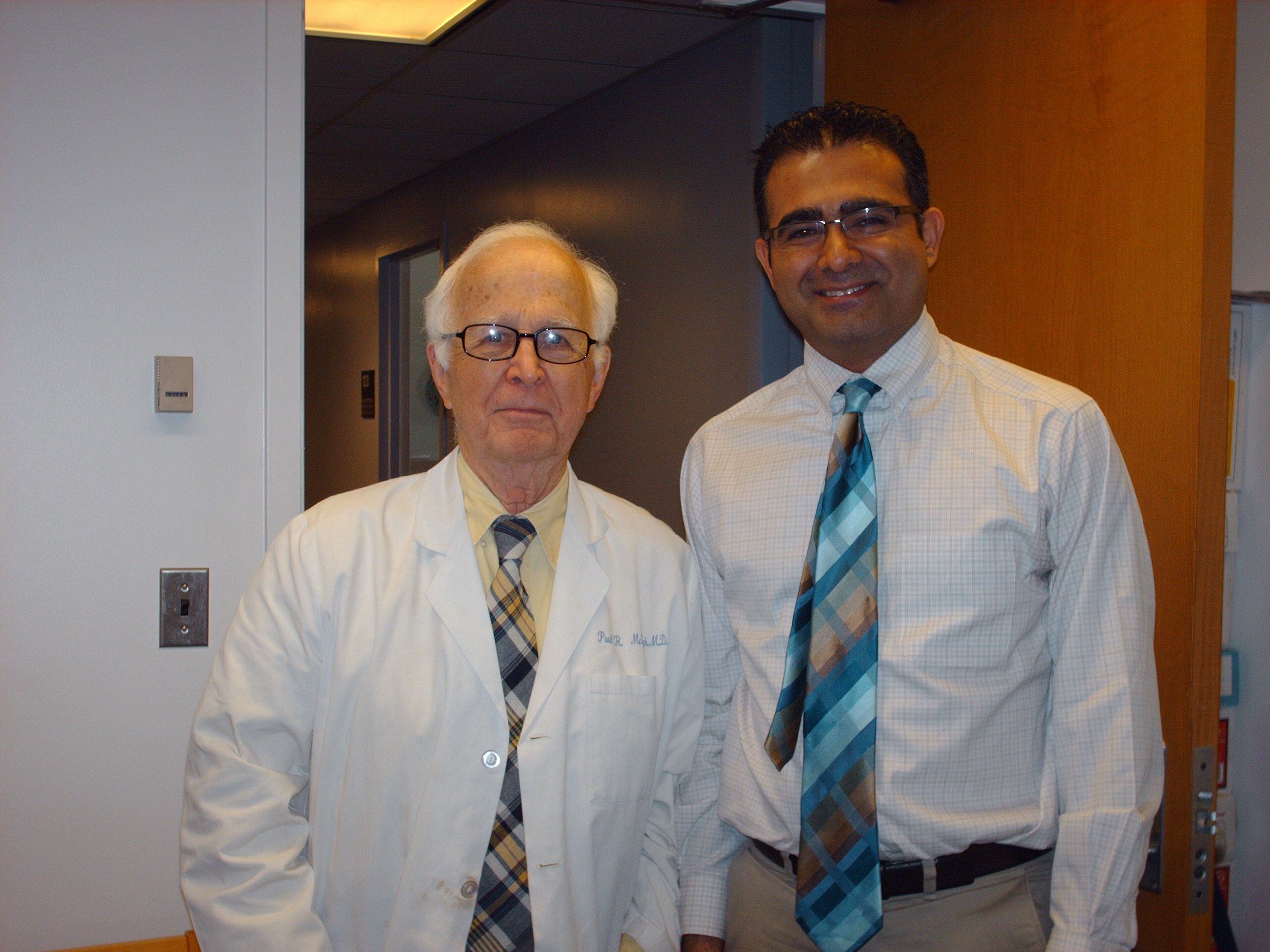
I had wonderful training from the best people in neurology and psychiatry in the world, I think. I had neurology training at Massachusetts General Hospital from Professor Raymond Adams, and I had psychiatry training at the Institute of Psychiatry in London from Professor Aubrey Lewis. Both of these people had a sense that psychiatry had to develop a coherent and comprehensive structure — ultimately to find a way to understand the nature of the disorders.
The problem between neurology and psychiatry was that neurologists had a clear idea of what their disorders were in nature — they were, after all, injuries to the brain and they could take the form of any pathology. Whereas the psychiatrists were uncertain. We used words like "endogenous" and "exogenous" conditions. These were unsatisfactory concepts to people like Dr. Aubrey Lewis — he thought you could not distinguish these from the presentations of depressed patients. So that is how I came to be thinking about what was fundamental to psychiatry: what is the nature of mental illness.
No, I and Dr. Phillip Slavney started working on the Perspectives when we were at the University of Oregon, actually. We decided that we would write a book, but we were not exactly certain about what kind of book we would write to present our point of view. At first we decided to write a small textbook where we would describe our method a little — but one day he and I agreed on what we should be doing. We would be talking about how, in a methodological way, with emphasis on the method of assessment, we might be able to differentiate the families of mental disorders — and thus come to say what we believe mental illness is.
No, not really, but being at Hopkins gave me a better forum and more support fundamentally for the enterprise of brainstorming. After all, I had very good students and very good colleagues — I could share with them and get back from them. And also, of course, working with Dr. Timothy Moran in the laboratory studying a basic behavior — food intake — I was extending my understanding of behavior and its controls.
I was experiencing resistance in the 1970s from the psychoanalytic community. Most of the resistance was directed more at my teaching in general to medical students than specifically at the Perspectives — even though I was making the point to the psychoanalysts that, after all, the way to understand their work was to appreciate that the life story of the patient was important to understanding mental disorders.
It was intended to encompass what they had accomplished. The things they had accomplished, I believe, could be encompassed within this. They, on the other hand, felt that their contributions were replaced throughout the Perspectives. In fact, one said: "When I read the first page, it gets my dukes up."
"DSM was the hare and we were the tortoise. And now we are kind of catching up."
— Dr. Paul R. McHughThe idea first went out with Dr. Robert Robinson at the University of Iowa and Dr. Marshall Folstein at Tufts Medical School. The real problem for us — if we talk about the acceptance of the Perspectives Model — is that it appeared at exactly the time when DSM-III appeared. They were out of the gates together, and DSM was the hare and we were the tortoise. And now we are kind of catching up.
The DSM approach — ignoring all aspects of generation or cause, only looking at symptoms — is beginning to reach its 30th year. And now people are wondering. We think: look, it would not be odd now to bring our thoughts to psychiatrists who are acquainted with DSM-III or IV. They would not find it hard to begin thinking with the Perspectives.
Particularly if we could persuade the APA that instead of their Axis organization, perhaps Axis I could include only the conditions likely to be brain diseases; Axis II could continue as it is — personality and the dimensional perspective; Axis III could be replaced with the behavior perspective; and Axis IV could be the life story. It would not be all that much of a change. Then maybe people would begin to see that instead of everything being Axis I, some of our patients are Axis II, III, IV — now identified through the dimensional, behavioral, and life story perspectives. And I think that is what is going to probably happen.
No, I do not believe at this moment they are convinced. They are the hare and we are the tortoise. They have to complete and finish their run. Even the discipline itself will see the ultimate need to replace the symptom-descriptive mode of classification and take on a generative and causal mode.
All fields go through a descriptive phase — and the only criticism you can offer them is that they stayed in the descriptive phase longer than they should. We are thinking that now psychiatry has come to the end — or should have come to the end — of its descriptive phase alone.
Right now we are thinking in terms of generative likelihood: that schizophrenia is a different kind of disorder than PTSD, which is also a different kind of disorder than alcoholism or addiction, which is also a different kind of disorder than histrionic personality. We psychiatrists are taking care of all those kinds of patients and would like not only to understand why the therapy needs to be different for each one of those conditions, but also that research domains and research directions will be different. Then we would have a heuristic classification — not the field guide which is only useful for reliability of diagnosis.
"Mental life is an emergent property of the brain. Like any other emergent property in science, it has its own features of action and features of disorder."
— Dr. Paul R. McHughI hope that all of my trainees feel that way. It is our intention to point out that we are medical people. We want to be sure that medical people see that the domain of psychological life is a domain unplummeted by biology — and yet has a biological domain itself, though with its own rules and ways of going awry.
You and I have talked about this before: we need to persuade them that mental life is an emergent property of the brain. Like any other emergent property in science, it has its own features of action and features of disorder. If people did not see that point, they would think that in the physical domain, the study of hydrodynamics is the study of hydrogen and oxygen — rather than the fluidity of water itself, which emerges from those two elements.